
Cold Blooded Murder
A Policeman's Tale, Part 20

“A desk is a dangerous place from which to view the world.” ~John Le Carré
The Field Marshals
One day, in a fever dream of promotion, a lieutenant schemes up a new project. It is designed for him to demonstrate his efforts at holding people accountable. By holding people accountable, and creating yet another powerpoint full of charts and Venn diagrams for the other promotable princelings, he will showcase his fitness for elevation to the rank of Captain—the land of take-home cars and three hour lunches.
Elevation in the palace court actually works this way, you finally learn, and against your will, a fact that rolls into your precious little tent of ideals about hot dogs and apple pie and explodes like a grenade, shattering your naive daydream that the people in command of your department are there because they possess a mastery of police tactics and strategy and superior qualities of human leadership.
Because they don’t, and they still won’t, no matter how many times they queue up inspirational segments from HBOs Band of Brothers for their Leadership Development Course. You are eventually sent to that, and spend most of the endless sessions trying not to vomit from the vertigo induced by the vast distances between what they say and who they demonstrably are. They seem to assume that elevation to a Captain’s rank is proof enough of their bonafides. But it’s a bad read on the process and the rank because their leadership bears no resemblance whatsoever to any of those brave men from Currahee that defeated the Nazis—a notable oversight of an obvious fact that utterly escapes their little bubbles of comprehension.
I am Captain, therefore I am.
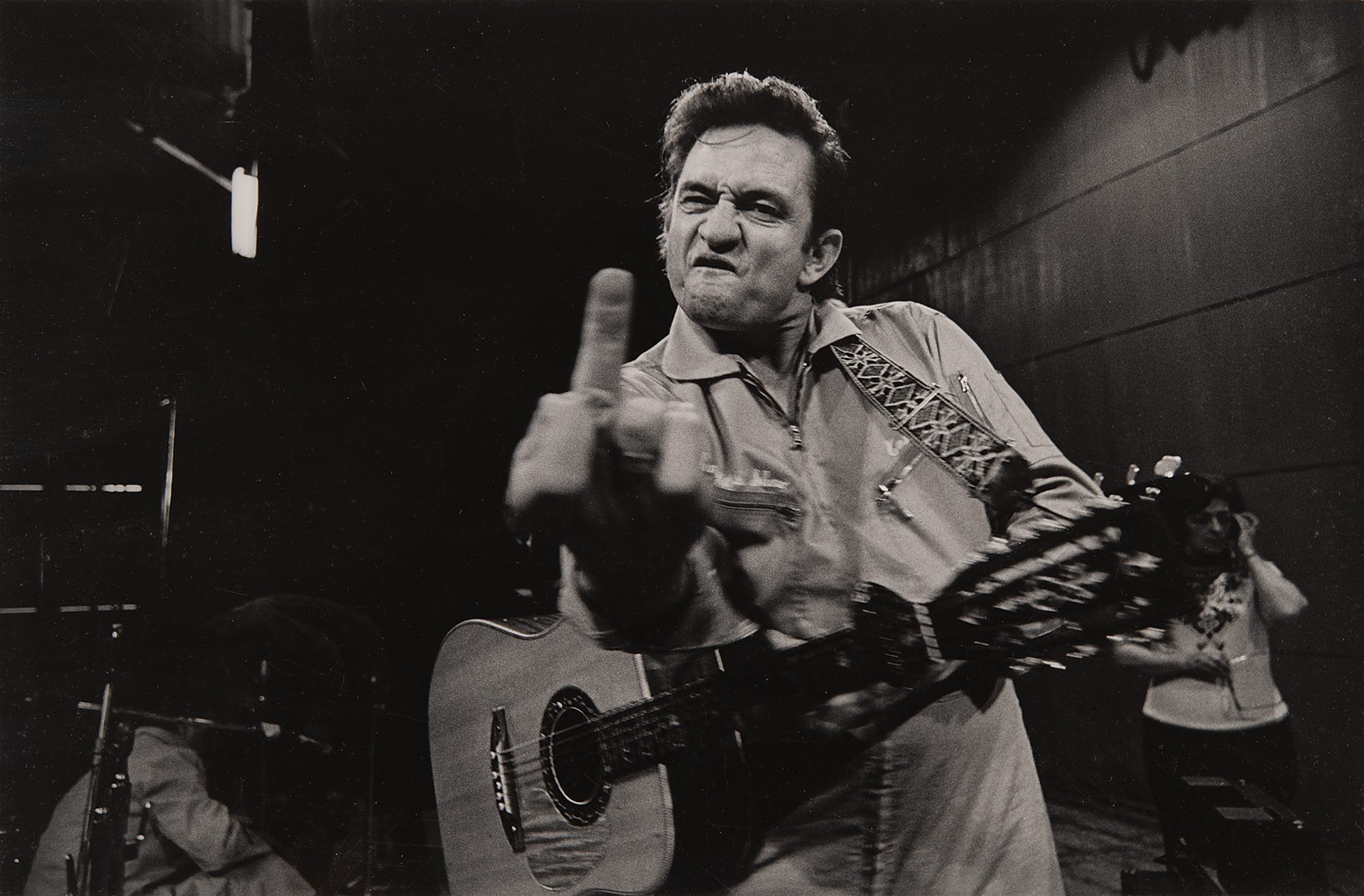
But it takes some maneuvering among the fops and caterpillars who crowd the Chief’s presence chamber to finally get the bars pinned on, and this lieutenant’s brilliant midnight inspiration is to require everyone on patrol to begin maintaining a handwritten patrol log. This is both an egregious redundancy and an abomination created to address a problem that doesn’t exist, and that’s the beauty of it. You laugh, but it’s a promotable make-work project that sings on the third floor. Like most pronouncements sent down from Olympus it has nothing to do with anything that matters, and where it finally lands it will only add to the considerable load of burdens you haul around in your aging police car with its oil leak, its failing brakes, and an MDC terminal that suffers frequent seizures and often just dies back to a blinking blue curser on the screen. One night, violating several pages worth of policy by using city property to create fuckery, you print out a picture of Johnny Cash flipping the bird to the camera at San Quentin, and tape that to the blank screen because the computer is otherwise useless and the image of a snarling Man in Black precisely matches your souring sentiment toward almost anyone above the rank of sergeant.
That wasn’t who you were when David Montanez was murdered on Ortega Street, but time in the uniform of your city screams by in an endless reel of barbed absurdities and it is the person, you notice when alone with your thoughts, or in the way your wife looks at you after you deliver yet another sardonic comment about the human condition at dinner in mixed company, that you are slowly becoming.
A police department is not a meritocracy. It is a petty fiefdom full of palace intrigue, with mincing little widgets of pretend authority and upwardly mobile suction who like to make the smallest gestures of command while imagining, somewhere in the deepest recesses of their id, that they are as capable and impressive as Field Marshall Montgomery at El Alamein. It’s an image they love to project but that is difficult to maintain because with rare exceptions it isn’t who they actually are. They’ve out-promoted their talent for command.
The evidence comes to life one afternoon, and you weren’t even looking for it, during a patrol briefing when a genius cop somewhere in the building picks up the phone, hits the number for the intercom, and blasts a submarine’s dive klaxon through the entire station in the middle of the Captain’s first command briefing. The dive klaxon explodes a poorly rehearsed foray into his expectations and pithy musings on organizational leadership. You sit in your wonky briefing chair, long ready to just get the fuck out of there and hit the streets, biting your cheek to hold back an involuntary eruption of mirth, sucking in little wafts of your rancid body armor to stuff it down, and watch the blood drain out of the Captain’s face—to be replaced instantly with the bewildered and angry grimace of a man without the verve of control his new rank demands—all while the overhead speakers sound off with: Ahooga, Ahooga, Ahooga, and the submarine is ordered to dive! dive! dive!
After an exhaustive internal investigation, the culprit is never identified.
A new captain might, for instance, wage war against the tinting on the crime lab window. He does this because he has built his portfolio on notions of transparency, he’s given speeches about it to local service organizations, for fuck’s sake, and he believes, in his heart of hearts, that the crime lab guys are engaged in highly suspicious activities behind that infuriating blackout tint.
The police department, and therefore public safety, can only be improved if he orders the tint removed—he’s holding people accountable—so that he can press his fatty cheeks and weird mustache against the glass to see what it is those furtive lab guys are actually doing in there. Perhaps, cops speculate in their various cones of silence, he imagines feats of necromancy with bubbling beakers and druidic incantations. He fears a rave party under the fumigation hood. He’s been to the FBI National Academy and is now building a conspiracy of infiltration by a secretly extremist lab tech with a suspicious last name. The tension around this affront of tintery builds steadily as zero hour approaches, first as rumors, and then finally comes crashing down as a sternly worded Memorandum announcing that, by order of the Field Marshal himself, this egregious lack of transparency is over.
This is the first and only thing he will ever do as a Captain of Police. You visit his office one day, for some sad and forgettable reason, and find him scrolling through pictures of hydraulic powered lowriders on his desktop. The kind of lowriders that bounce on their front tires while tattooed Mexican hynas with huge tits and mini skirts and stiletto heels go leaping around in the background with Tec 9s and five pound spliffs. He’s doing that, but there is nothing on his desk. It’s as if nobody actually works in there, except for the bizarre motivational poster of a Mongolian Eagle Hunter on the far wall that says Soar Like A Great Spirit and has utterly nothing to do with the man whose office you are standing in. He couldn’t have put it there, because scrolling for lowriders and tittties is what he really does, aside from a specialization in the public mangling of phrases and aphorisms.
