
Lights and Sirens
Part 50 of A Policeman's Tale of the American Riviera

“May the work of your hands be a sign of gratitude and reverence to the human condition.”
~Mahatma Gandhi
Happy Endings
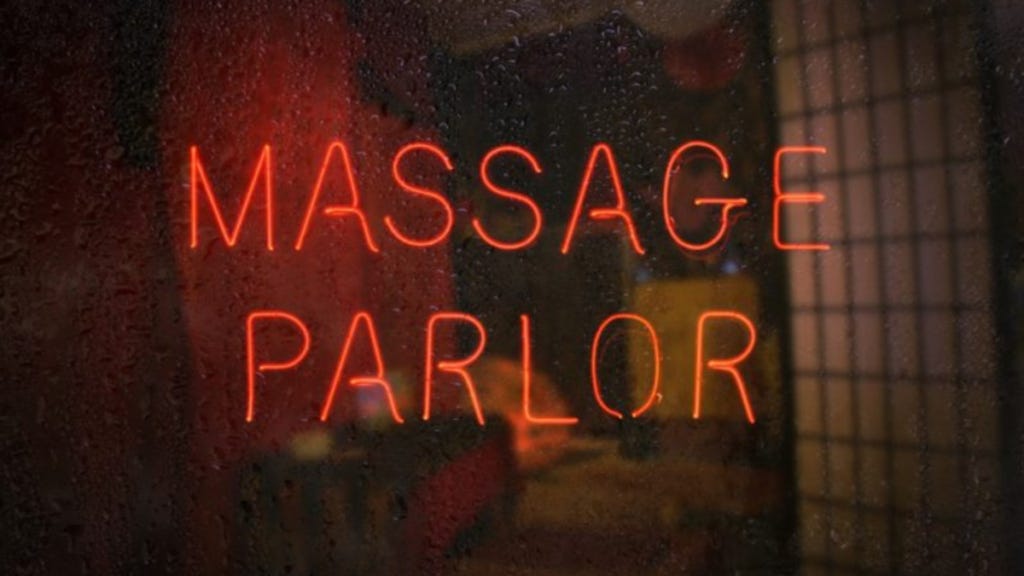
There are no straight lines in nature, and nothing in narcotics work is linear. You may have been assigned to work a gang homicide and you may be on the SWAT team— occasionally smashing felony warrants or road killing robbers on the loose—and you may be laboring under a police administration whose only guiding principle is to pump more and more friction into the machine, but the finish line is sometimes a circuitous route back to the starting line, the road from one to the other engineered by the lesser angels of human nature. Which is how you find yourself, in the middle of everything else, in a steaming asphalt parking lot on the north end of Santa Barbara, packed four deep in a mini-van across the street from a strip mall where Madame Yu and her stable of trafficked girls from Xinjiang are pumping out the happy endings for a steady stream of lonely Santa Barbarians.
To be clear, the City Mothers don’t give a shit about prostitution. It isn’t even on their radar, that wonky apparatus that would otherwise tune them in to what is actually happening in the city they claim to shepherd. They missed the gang thing too, by the proverbial country mile, and Santa Barbara isn’t Gotham, where the mayor seems to have a finger on the pulse of things. That’s probably even the police department’s fault, because it is unclear if anyone above the rank of sergeant ever tells the truth about anything at all. At least not in political company. It’s highly unlikely the city council is even aware of the van loads of Mexican trannies brought in from Oxnard every weekend, or have any idea that the city’s hotels and motels are filled to overflowing with Craigslist and Backpage hookers, or that co-ed scholars from City College and UCSB are running lucrative escort services all over the Riviera when the sun goes down. And even if they knew it might not interest them, insulated as they are by their own expansive biases in favor of sex workers and drug dealers—whatever the sordid consequences.
It’s likely that in order to lean on the Chief of Police, to seek some mitigation in the thriving and entirely lurid business of transactional sex, they would have to see some things that the cops see. Runaways lured away from Kansas and transported to Santa Barbara in a stolen car by a blown out cokehead at gunpoint, forced to turn tricks in gas station bathrooms across the Great Plains and over the Rocky Mountains for a couple of gallons of unleaded, and finally held hostage in a corner room at the Motel 6 on Upper State Street while their parolee boyfriend works the phones and his stolen laptop to arrange dates with an endless parade of sweaty Mexican roofers and zombie methhead drywallers. Maybe, you sometimes think, if they saw what the cops see, the City Mothers would be more interested in justice for the victims they celebrate as entrepreneurs.
