
Lights and Sirens
Part 45 of A Policeman's Tale of the American Riviera

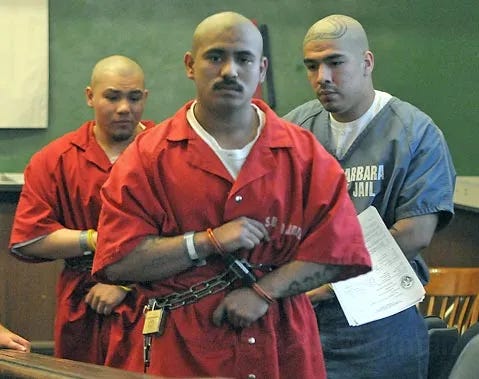
“When I went to prison and came out, it was like another stripe being added to my shoulder—another notch of respect on my belt. On the streets, you cannot get a name until you do something. You have to prove who you are by doing something outrageous, like shooting someone from a rival gang. It allowed others to see what type of person you were, and established the fact that you were ready for anything. Back in the day, what we were looking for was for someone to have our backs. So every time I did something and was recognized for what I did, it gave me more nerves to continue. After the deed was all said and done, and we were hanging on the blocks, everyone is praising you and talking about what you did. You all should have been there. You should have seen how Taco rushed up on that fella and dealt with him. Those praises were like drugs that eventually poison the mind, and gave you more inspiration to do things to have more people talking about you. People recognizing you as one who isn’t scared, one who is ready to do whatever is needed.”
~ Troit Lynes
A Pertinent Call
When there is a 223% increase in gang violence in your city, like there was in Santa Barbara, somebody has to start paying attention. The murders of Angel Linares and Lorenzo Carachure weren’t happening in a vacuum. They weren’t one-offs, because everything in the gang world is connected to everything else. The street cops knew it because they were chasing hoods all over the city for every conceivable kind of crime. The gang unit knew it because it was their job to plow neck deep into the players and keep the hatches battened down. The major crimes detectives knew it because it wasn’t just homicides landing on their desks, it was assaults with deadly weapons, a deluge of attacks where people didn’t die, including the infamous “Face Off” caper where Eastside gangsters carved a kid’s face off with a knife and left him for dead on the sidewalk. The narcs knew it because names like Boxer and Shy Boy and Oso kept popping up in dope investigations.
All things are connected, and sometimes in the strangest of ways. If you are a good cop, and Santa Barbara was a city with a wealth of good cops, you are always looking to put the pieces together, to map the invisible criminal networks that seem to exist in the ether all around you. Robert Bobo Sosa was a Santa Bruta kid, and the first Nuestra Familia General, and his name and his influence on gang life was still on the lips of the OGs because—before Ruben Mize stepped up to make his name—Santa Barbara was a kind of gangland Switzerland, a neutral country where the great powers—Nuestra Familia and the Mexican Mafia—were always capering in the shadows.
But they stayed in the shadows. Because it was good for business.
Years later, when it was all over and you were out in the shop building a birdhouse for the bluebirds that migrate to your mountain redoubt, you would talk to Chris Diaz on the phone and he would explain it better than most— because it had been his life. “Everyone could make money in Santa Barbara,” he said. It was stupid, he thought, a terrible mistake, to start killing people in the twisted turf logic of East vs. West, and for the simplest of reasons. It was stupid because: “Now you are fucking with old white people money. They don’t like that shit, and they will start smashing.”
And Chris was right, of course. The third floor and the City Council and most of the city’s citizens were sleepwalking around from one gorgeous sunset to the next, from one Night Moves to another, either oblivious or deliberately ignorant about what was really happening on the lower east side, or in the meaner corridors of the west side. But when the homeys started killing each other where no one could ignore it anymore, it woke up elements of old white people money who started leaning on the Chief of Police and the somnambulant City Councilors to get a handle on it. And to his credit, the Chief started to make his move.
